Sound
A vibration that travels through the air and that we can hear.
Example A plucked guitar string vibrates and makes a sound.
Explore plain-language explanations and simple examples. No instrument or music-reading experience needed.
No matching terms. Try a different search or select “All topics.”
Start with what music is made of: sounds that can be higher or lower, longer or shorter.
A vibration that travels through the air and that we can hear.
Example A plucked guitar string vibrates and makes a sound.
How high or low a sound seems. Pitch is different from volume.
Example A piccolo usually sounds higher than a bass guitar.
A named musical sound. In written music, a note symbol also tells a player how long to hold it.
Example C is a note name; a written C can be short or long.
The note letters A, B, C, D, E, F and G. After G, the letter pattern starts again.
Example … E, F, G, A, B, C …
The distance from one note to the next note with the same letter name, higher or lower.
Example The higher C on a piano sounds like C, but in a higher range.
A one-step move in pitch in the standard Western note system. On a piano, it is the distance to the very next key.
Example C to C-sharp is one semitone; E to F is also one semitone.
A sign that raises a note by one semitone.
Example C-sharp is one piano key higher than C.
A sign that lowers a note by one semitone.
Example B-flat is one piano key lower than B.
A sign that cancels a sharp or flat and returns a note to its unaltered pitch.
Example If a bar has shown F-sharp, an F-natural sign changes it back to F.
These ideas help you feel the steady pulse, understand note lengths and play together in time.
The steady underlying throb you can tap your foot to.
Example Tap evenly along with a song's main count.
One regular count in the pulse.
Example Count “1, 2, 3, 4” along with a steady pop song.
The pattern of long, short and silent moments placed over the beat.
Example A drummer may play several quick notes while the foot keeps a steady pulse.
How fast or slow the beat moves.
Example A slow ballad has a slower tempo than a dance track.
Beats per minute: a number used to describe tempo.
Example At 60 BPM, one beat lasts about one second.
A small group of beats. Bar lines divide the written music into measures.
Example In 4/4 time, a measure contains four quarter-note beats.
Two numbers at the start of written music that show how beats are grouped. The top number tells how many beat-units are in a measure; the bottom number tells which note value is the unit.
Example 4/4 groups four quarter-note beats in each measure.
Symbols that show how long notes last relative to one another. Their exact beat count depends on the time signature.
Example In 4/4, a whole note usually lasts four beats, a half note two, a quarter note one, and an eighth note half a beat.
A written symbol that means to leave a measured space of silence.
Example A quarter rest is one beat of silence in 4/4.
Splitting a beat into smaller, even parts to help you count rhythms.
Example Count “1 and 2 and” to feel eighth-note subdivisions.
An emphasis on an unexpected part of the beat, often between the main counts.
Example A snare hit between the steady counts can make a groove feel surprising.
The feel created by how a rhythm's notes sit against the beat.
Example A relaxed groove can feel laid-back even when the tempo is steady.
Melody is the part you can often hum. Scales and keys describe the note patterns that help shape it.
A sequence of notes heard as one musical line.
Example The tune you hum after a song ends is its melody.
A short, recognizable musical idea that can return or change throughout a piece.
Example A three-note pattern repeated in different places can become a motif.
A set of notes arranged in order from low to high or high to low.
Example The C major scale uses C, D, E, F, G, A and B.
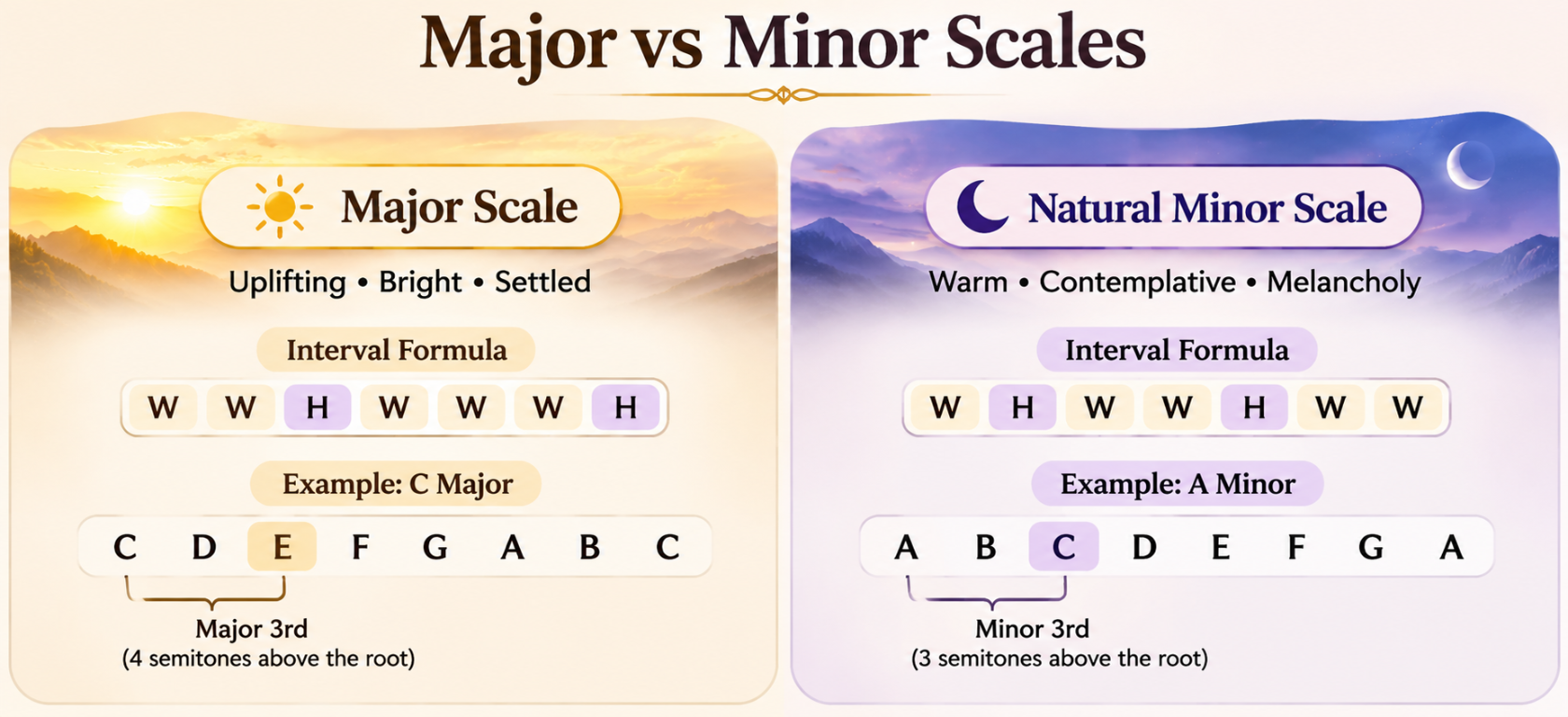
A scale with a bright, uplifting sound, following the pattern W–W–H–W–W–W–H.
Example C Major – C, D, E, F, G, A, B, C.
A scale with a warmer, more melancholic sound, following the natural minor pattern W–H–W–W–H–W–W.
Example A Minor – A, B, C, D, E, F, G, A.
The pitch distance between two notes.
Example C up to the next G spans a fifth.
The group of notes and the central “home” note that a piece of music is organized around.
Example A song in C major often feels settled when it returns to C.
The home note, or first note of the scale, in a key.
Example C is the tonic in C major.
Sharps or flats written at the start of a staff to show which notes are usually altered throughout a piece.
Example A key signature with one sharp usually means F is played as F-sharp.
Harmony is what happens when notes support one another, often underneath a melody.
The combination of notes sounding together, and how those notes support a melody.
Example A singer's melody can be supported by piano chords.
Three or more different notes played or heard together.
Example C, E and G played together make a C major chord.
A basic chord made from three notes, often built by selecting every other note from a scale.
Example C–E–G is a C major triad.
The note a chord is named after. It is not always the lowest note being played.
Example C is the root of a C major chord.
A sequence of chords that provides the harmony for a section of music.
Example A song may repeat the same four chords through each verse.
The low-pitched musical part that supports the harmony and often connects with the drums.
Example A bass player might play the root of each chord.
The parts that support the main melody, such as chords, bass and rhythm.
Example A piano can accompany a singer without playing the singer's melody.
Musicians shape notes with changes in loudness, touch and tone color.
Instructions or choices about how loud or soft the music should be.
Example A chorus may be louder than the verse before it.
A music marking meaning soft. It is separate from the piano instrument.
Example A p above a passage asks the player to play softly.
A music marking meaning loud.
Example An f above a passage asks the player to play loudly.
A gradual increase in loudness.
Example A song may build from a quiet verse into a powerful chorus.
A gradual decrease in loudness.
Example A final note can fade away with a diminuendo.
The way notes are started, connected or separated.
Example A melody can be played smoothly or with short, detached notes.
An instruction to play notes short and detached.
Example Staccato notes have small spaces between them.
An instruction to connect notes smoothly.
Example A legato melody flows from one note into the next.
The tone color that makes one sound or instrument different from another, even at the same pitch.
Example A flute and a guitar can play the same note but sound different.
The low, middle or high range where notes are played.
Example A piano's left side is low register; its right side is high register.
Written music gives players a shared way to see pitch, timing and musical instructions.
Five horizontal lines and the spaces between them where music notes are written.
Example A note can sit on a line or in a space.
A symbol at the start of a staff that tells you which pitches its lines and spaces represent.
Example The treble and bass clefs assign different note names to the same staff position.
A clef commonly used for higher-pitched parts, such as flute, violin or the right hand of piano music.
Example The treble-clef lines from bottom to top are E, G, B, D and F.
A clef commonly used for lower-pitched parts, such as bass guitar, cello or the left hand of piano music.
Example The bass-clef lines from bottom to top are G, B, D, F and A.
A vertical line on a staff that separates one measure from the next.
Example In 4/4, each space between bar lines contains four quarter-note beats.
Written music showing the parts for one or more instruments or voices.
Example A band score can show drums, bass, chords and melody together.
The music written for one instrument or voice within a larger piece.
Example A drummer's part shows the rhythms for the drum kit.
Song sections give music a shape and help listeners recognize what is coming back or changing.
The opening section that leads into the main part of a song.
Example A song may begin with four bars of drums before the singer enters.
A section where the music often repeats while the words change to tell more of the story.
Example Verse one and verse two may use the same melody with different lyrics.
A repeated section that usually contains the song's main idea or hook.
Example The words and melody of the chorus return several times.
A contrasting section that gives a song a change before returning to a familiar section.
Example A bridge may introduce a new chord pattern before the final chorus.
The closing section of a song.
Example An outro can repeat the chorus or gradually fade out.
The plan for which instruments or voices play, and when they enter or stop.
Example A song might start with voice and guitar, then add bass and drums in the chorus.
Build on the beginner basics with lessons about the notes, distances and patterns behind the music you hear.
A pitch is how high or low a musical sound feels. The Western musical alphabet uses seven natural letter names: A, B, C, D, E, F, and G.
After G, the musical pattern restarts at A in a higher register (an octave). Between most of these natural notes sit five accidental notes (sharps ♯ and flats ♭), giving us twelve total chromatic pitches within every octave. On a piano keyboard, moving one key immediately to the right raises pitch by one semitone (half step). Understanding this cyclic alphabet of 12 notes is the essential foundation of all scales, chords, and melodies.
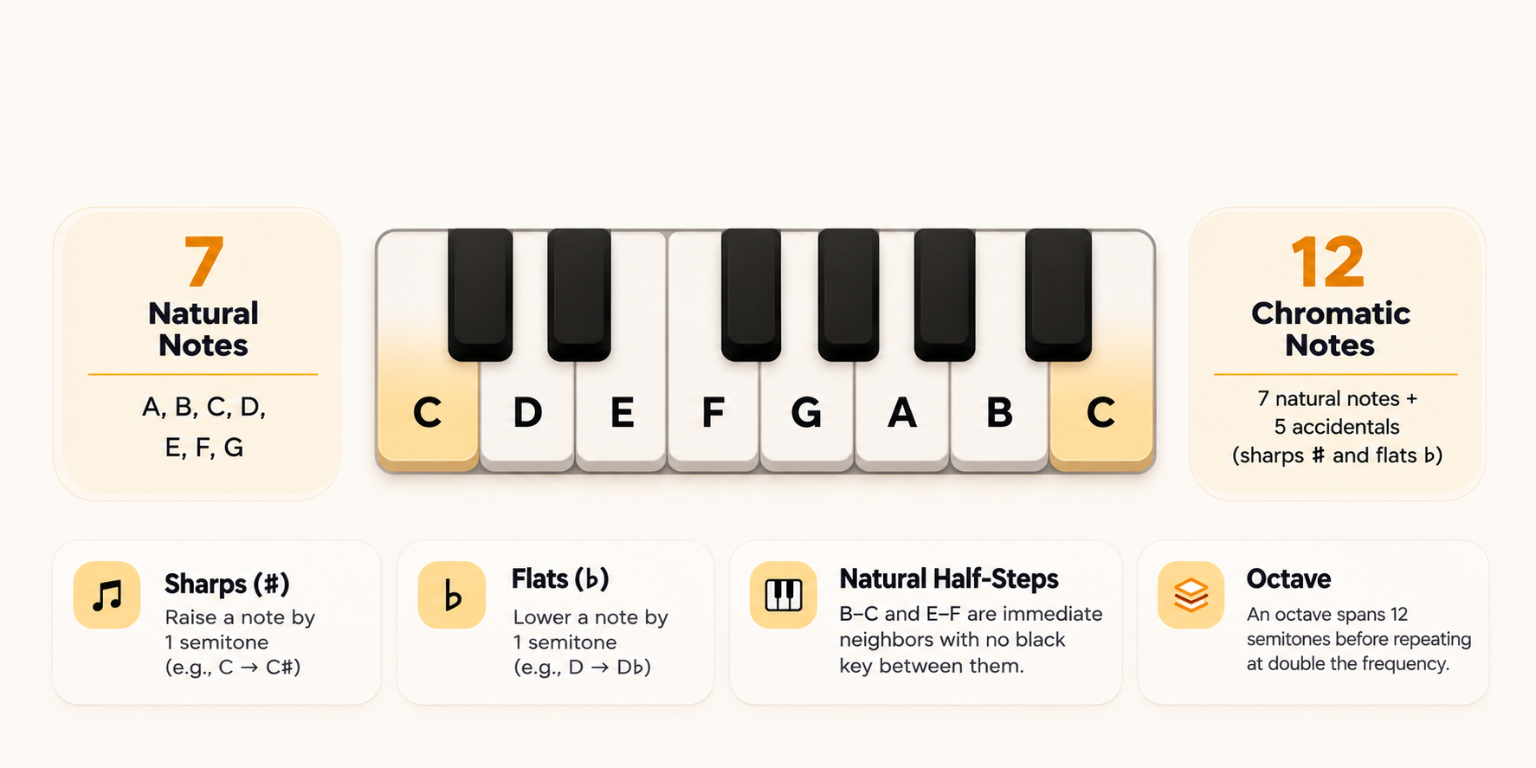
Tap the piano keys in the Scale Explorer from C to B, listening to how pitch climbs steadily with each semitone step.
Explore the Scale Explorer →Half steps and whole steps are the fundamental distance measurements in music, used to construct every scale, chord, and melody.
A half step (semitone) is the shortest musical distance between two adjacent keys on a piano keyboard. A whole step (whole tone) equals two half steps—skipping one key in between. Most white piano keys have a black key separating them, making the move between them a whole step (such as C to D). However, the pairs E–F and B–C are physical neighbors with no black key in between, making them natural half steps.

Select different scale recipes in the explorer to see how swapping whole and half step positions transforms the musical mood.
Explore the Scale Explorer →Major and minor scales are two basic types of musical scales. They create different musical feelings: major scales generally sound bright and happy, while minor scales often sound softer and more melancholic.
A musical scale is a sequence of seven notes arranged using a specific pattern of whole steps (W) and half steps (H).
Examples:
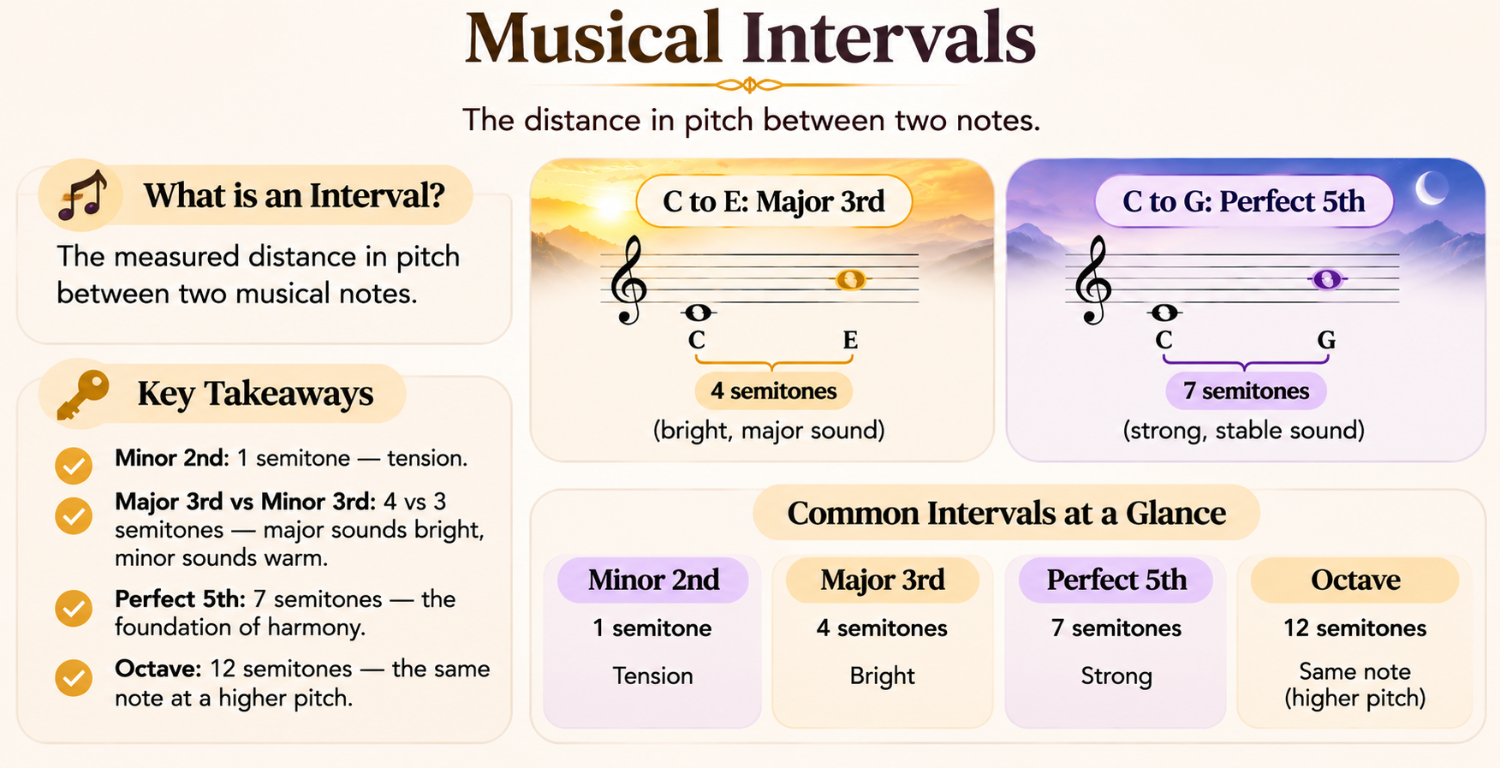
A musical interval is the distance in pitch between two notes. Intervals help create melodies, build chords, and shape the overall sound of music.
Intervals describe how far apart two musical notes are. They are identified by their note distance (such as 2nd, 3rd, 4th, or 5th) and their quality (such as major, minor, or perfect).
For example:
Click through the Chord Lab triads below the scale explorer to hear how stacking thirds creates rich three-note harmony.
Explore the Scale Explorer →Explore harmony, train your ear or practice keeping time.
Choose a root and scale recipe, play notes on the two-octave piano, and explore chord shapes.
Pick a starting root note and a recipe.
Tap keys individually or play the whole scale.
Each shape stacks every other note in the scale. Tap any card to hear how it sounds.
Choose a chord shape to hear it.
Explore key relationships on the circle, then practice them in the Orbit Hopper mission.
A perfect fifth is a distance of seven semitones. Start at C and move clockwise: C to G, then G to D. Each step adds one sharp to the key signature. Move counterclockwise by fifths and each step adds a flat.
Keys close together on the circle share most of their notes. That makes the circle a useful map for choosing chords, changing keys, and writing songs.
Select a key on the circle to explore its scale below.
Every major key has a relative minor that uses the same seven notes and the same key signature, but treats a different note as home. Find it on the inner ring.
For example, C major and A minor both use the white keys. C major feels resolved on C; A minor feels resolved on A. In a major scale, the relative minor starts on the sixth note. You can also find it by moving down three semitones from the major key's root.
Clockwise goes up a fifth. The relative minor is the inner-ring partner. Tap any pair on the circle to hear its scale.
Use your flight thrusters to travel around the Circle of Fifths. Hop clockwise to climb fifths, or dive inward to explore the relative minor ring!
Set a tempo, tap along, and test your timing when the beat goes quiet.
A metronome keeps a steady pulse so you can practice difficult passages slowly and build muscle memory. Start slow, play perfectly, then gradually increase the tempo.
Set the tempo 20% below comfortable speed and play perfectly for 5 minutes. Then raise it 5 BPM at a time.
Keep the beat alive when the click disappears. Listen to the count-in, hold the tempo through the silent gap, and tap on beat.
Listen to a mystery note and choose the matching pitch in a five-round listening game.
Each round, a mystery note plays. Choose the correct note from four options. Get a streak going for bonus points!
Press the ♫ button to hear the mystery note again any time.
10 points per correct answer. 3-in-a-row earns a 5-point streak bonus.
Keep your streak alive by not making mistakes!
Take a chord or rhythm into the Jam Music Engine. Create a loop, then invite a friend.